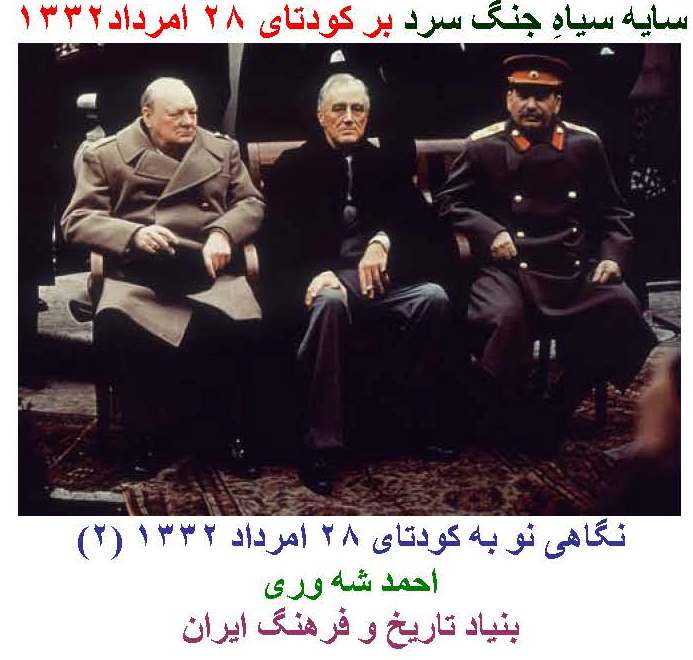
Cold War and the August 18 1953 Coup in Iran Between 1945 and 1960, many former colonies gained independence and formed the Third World, where control and expansion of influence over the Third World became one of the main areas of conflict between the United States and the Soviet Union. On April 12, Franklin Roosevelt died and Harry S. Truman became the president of the United States. The research about what happened between the death of Roosevelt and the beginning of the Eisenhower administration shows that in these 8 years, the foreign policy of cooperation with the Soviet Union during Roosevelt’s time was replaced by the policy of confronting the Soviet Union, spreading communism, or at least limiting the Soviet Union to the border area. He gave it and its satellites; A policy that cost billions of dollars to implement, and after the collapse of the Soviet Union on the last day of 1991, its aftershocks in the form of terrorism and destructive competition still continue; It was with Truman that the approach of American foreign policy changed from cooperation and understanding to confrontation, enmity, war, and imperialism. In the Potsdam Conference Truman was much more suspicious of the Soviets than Roosevelt had been and became increasingly suspicious of Stalin’s intentions[1]. Truman and his advisers saw Soviet actions in Eastern Europe as aggressive expansionism, which was incompatible with the agreements committed to by Stalin at Yalta in February. In addition, Truman became aware of possible complications elsewhere after Stalin had objected to Churchill’s proposal for an Allied withdrawal from Iran ahead of the schedule that had been agreed at the Tehran Conference. The Potsdam Conference was the only time that Truman met Stalin in person[2]. In the final declaration of this conference, it was emphasized that the Soviet and British forces would leave Iran 6 months after the end of all conflicts[3]. The Potsdam Conference with a stronger relationship among the three governments as a consequence of their collaboration, which renewed confidence that together with the other United Nations, they would ensure the creation of a just and enduring peace. Nevertheless, within 18 months relations had deteriorated and the Cold War had emerged[4]. The immediate post-1945 period may have been the historical high point for the popularity of communist ideology. The burdens the Red Army and the Soviet Union endured had earned it massive respect which, had it been fully exploited by Joseph Stalin, had a good chance of resulting in a communist Europe. The political situation in Iran was a flashpoint between the major players in 1945–46, with the Soviet Union sponsoring two breakaway provinces in northern Iran, adjacent to the Azerbaijan Soviet Socialist Republic. Soviet troops were stationed in northwestern Iran as part of the Anglo-Soviet invasion of Iran during the war. They not only refused to withdraw in 1945 but backed revolts that established short-lived, pro-Soviet separatist national states called the Azerbaijan People’s Government and the Republic of Kurdistan. The issue was debated at the United Nations, and in 1946 Moscow abandoned its position, and the conflict was permanently resolved peacefully, with a pro-western government resuming control. Iran did not become a major battlefield of the Cold War, but it had its own history of confrontation with Britain and the United States[5]. The United States based its Cold War coalition primarily on the Baghdad Pact of 1955 which formed the Central Treaty Organization (CENTO), which included Iran, Iraq, Pakistan, Turkey, and the United Kingdom[6].
Reference: – George Lenczowski, American Presidents and the Middle East, (1990), pp. 7–13. 2- Harry S. Truman, Memoirs, Vol. 1: Year of Decisions (1955), p.380, cited in Lenczowski, American Presidents, p.10 Nash, Gary B. “The Troublesome Polish Question.” The American People: Creating a Nation and a Society. New York: Pearson Longman, 2008. Print. 3- Editors, History com. “Potsdam Conference”. HISTORY. Retrieved 2020-09-02. – 4- Lynn Etheridge Davis, The Cold War Begins: Soviet-American Conflict Over East Europe (2015) pp 288–334. And:: James L. Gormly, From Potsdam to the Cold War: Big Three Diplomacy, 1945-1947 (Scholarly Resources, 1990). 5 – Bruce R. Kuniholm, The Origins of the Cold War in the Near East: Great Power Conflict and Diplomacy in Iran, Turkey, and Greece (Princeton UP, 2014). And:: Arms, Encyclopedia of the Cold War (1994) pp 37–38, 400. 6 – Michael J. Cohen, “From ‘Cold’ to ‘Hot’ War: Allied Strategic and Military Interests in the Middle East after the Second World War.” Middle Eastern Studies 43.5 (2007): 725–748. And:: The Baghdad Pact: Anglo-American Defence Policies in the Middle East, 1950-59 – via Amazon. And:: Ayesha Jalal, “Towards the Baghdad Pact: South Asia and Middle East Defence in the Cold War, 1947–1955.” International History Review 11.3 (1989): 409–433.



 ADABSARA