
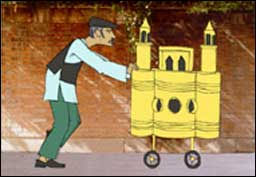
شهر شهرِ فرنگ ِ خوب تماشا کن 0085
Regardez notre ville! Notre ville est la belle ville de France
فردوسی شناسی 3
ردِ پای شاهنامه در تاریخ
برغم اینکه شاهنامه نویسی در زمان نگارش شاهنامه یکی از رایجترین کارهای نویسندگان عصر بوده و همان طور که گفته شد شاعران و نویسندگان متعددی قبل از فردوسی استادی و مهارت خود را در نوشتن شرح حال و سرنوشت دلاوران ایران آزموده بودند بطوری که در زمان خود حکیم توس تعداد قابل توجهی از معاصرین او با کارش آشنا بودند، جای تعجب است که در تاریخ بیهقی کمتر اشاره ای به این کارسترگ نمی شود. قدیمیترین کتابی که نام فردوسی و اثر جاودانه او ” شاهنامه” در آن آمده تاریخ سیستان است که در قرن پنجم نوشته شده است. بعد از آن نظامی عروضی سمرقندی است که در کتاب چهارمقاله خود از فردوسی و کتاب گرانسنگ شاهنامه یاد می کند. و از جمله دراین کتاب یاد می کند که علاء الدین غوری در فتح غزنین شاهنامه می خوانده است. در تاریخ گزیده نیز آمده است که طغرل بن ارسلان سلجوقی در جنگی که منجر به هلاک او شد شاهنامه می خوانده است.
اوّلین نسخه دستنویس شاهنامه که تاکنون شناخته شده، بظاهر نسخه دستنویس مربوط به اوایل سده هفتم هجری، یعنی نسخه موجود در کتابخانه فلورانس است که تاریخ 614 ق/ برابر597 ، را دارد. این نسخه تنها نیم نخستین شاهنامه را دارد. امّا از قرن هشتم به بعد تعداد نسخه های دستنویس شاهنامه روبه افزایش می گذارد.
“سیره فیروزشاه”
محمد السعید جمال الدین، از ادیبان قطر، در کنگره اخیر ِ بزرگداشت فردوسی در مقاله ای که با عنوان ” ادبیات عرب و شاهنامه” به این کنگره ارائه کرد، اظهار داشت که تا اواسط دهۀ1980 میلادی، تصورعامه اعراب براین بود که این داستانها از حماسه های عرب است تا این که دکتر محمد رجب النجار، استاد فرهنگ عامه در دانشگاه کویت، ثابت کرد این حماسه ها در حقیقت عبارت است از ترجمۀعامیانه مختصر و آزاد شاهنامه فردوسی[است] و چون این حماسه درقرن پنجم تألیف شده باید آن را مقدم بر ترجمه البنداری دانست[1]”. نسخه دستنویس شاهنامه به زبان عربی که توسط فتح بن علی بنداری اصفهانی در سال 620 -621 ق/ برابر603 و604 ترجمه و تهیه شده است.
نسخه دستنویس کتابخانه موزه بریتانیا که تاریخ نسخه برداری آن 675 ق/ برابر 656 می باشد.
نسخه دستنویس کتابخانه توپکاپی استانبول که درسال 731 ق / برابر710 نسخه برداری شده است.
نسخه دستنویس کتابخانه عمومی لنینگراد شوروی که در سال 733 ق/ برابر 712 نسخه برداری شده است.
نسخه خطی شاهنامه مجموعه خصوصی ح نیور [سیک]، ، که عبدالوهاب محمد قزوینی امکان دیدن آن را یافته، و در سال 741 ق / برابر 720 ، به سفارش ویا برای حاجی قوام وزیر شیخ ابواسحق اینجو، رونویسی شده است.
نسخه دستنویس کتابخانه قاهره که تاریخ نسخه برداری آن سال 741 ق / برابر 720 ، است.
نسخه دستنویس کتابخانه قاهره که تاریخ نسخه برداری آن سال 796 ق / برابر774 است.
نسخه دستنویس کتابخانه دانشگاه لیدن در هلند که تاریخ نسخه برداری آن سال 840 ق / برابر 816 است.
نسخه دستنویس کتابخانه موزه بریتانیا که تاریخ نسخه برداری آن سال 841 ق / برابر 817 است.
نسخه دستنویس کتابخانه ملّی پاریس که تاریخ نسخه برداری آن سال 844 ق / برابر 820 است.
نسخه دستنویس کتابخانه پاپ در واتیکان که تاریخ نسخه برداری آن سال 848 ق / برابر 824 است.
نسخه دستنویس کتابخانه مؤسسه خاورشناسی فرهنگستان علوم شوروی که تاریخ نسخه برداری آن سال 849 ق / برابر 825 است.
نسخه دستنویس کتابخانه دانشگاه اکسفورد که تاریخ نسخه برداری آن سال 852 ق / برابر 828 است.
نسخه دستنویس کتابخانه موزه بریتانیا که در سال 891 ق / برابر با 866 نسخه برداری شده است.
نسخه دستنویس کتابخانه دولتی برلین که درسال 894 ق / برابر 869 نسخه برداری شده است
نسخه دستنویس کتابخانه موزه توپکاپی در استانبول که درسال 903 ق / برابر 878 نسخه برداری شده است.
پانویس:
[1] -محمد السعید جمالدین، ص 610.
[2] H. Niever [Sic]
[3] Histoire des Rois des Perse
[4]- ر. ک. ستارزاده، ص1073.
[5]- ر. ک. مینوی؛ رستم وسهراب، ص6.
[6]- ر. ك. همان ، ص 7.
[7]- انیوسترانتسف، صص 25و16.
[8]- زریری، صص 14 و15.
منبع:
احمد شه وری. فردوسی و نوزایش فرهنگی و علمی ایران. شابک: 978-1477698310
Traces of the Shahnameh in History
Despite the fact that writing Shahnamehs was one of the most common practices among writers of the time, and as mentioned, many poets and writers before Ferdowsi had tested their mastery and skill in writing the biographies and destinies of Iran’s warriors, so much so that in Ferdowsi’s era, a significant number of his contemporaries were familiar with his work, it is surprising that Behaqi’s History makes little mention of this great achievement. The oldest book that mentions Ferdowsi and his immortal work Shahnameh is the History of Sistan, written in the fifth century. After that, Nezami Aruzi Samarqandi, in his Chahar Maqaleh, refers to Ferdowsi and his invaluable book Shahnameh. Among other things, this book notes that Ala al-Din Ghuri recited Shahnameh during his conquest of Ghazni. It is also recorded in Tarikh-e Guzideh that Tughril ibn Arslan Seljuqi was reading Shahnameh in a battle that led to his demise.
The earliest known manuscript of Shahnameh appears to be a handwritten copy from the early seventh century AH, specifically the manuscript held in the Florence Library, which dates to 614 AH / 597 CE. This manuscript only contains the first half of Shahnameh. However, from the eighth century onwards, the number of handwritten copies of Shahnameh increases.
“The Biography of Firuz Shah”
Muhammad al-Said Jamal al-Din, a literary scholar from Qatar, presented an article titled “Arabic Literature and Shahnameh” at the recent Ferdowsi Congress. He stated that until the mid-1980s, the general perception among Arabs was that these stories originated from Arab epics. However, Dr. Muhammad Rajab al-Najjar, a professor of folklore at Kuwait University, proved that these epics were actually simplified and loosely translated versions of Shahnameh in the common vernacular. Since these epics were compiled in the fifth century AH, they should be considered earlier than al-Bundari’s translation.
The handwritten Arabic translation of Shahnameh by Fath ibn Ali Bundari Isfahani was prepared in 620-621 AH / 603-604 CE.
- A manuscript in the British Museum Library, copied in 675 AH / 656 CE.
- A manuscript in the Topkapi Library in Istanbul, copied in 731 AH / 710 CE.
- A manuscript in the Leningrad Public Library in the Soviet Union, copied in 733 AH / 712 CE.
- A manuscript in a private collection of H. Niever [Sic], which Abdulwahab Muhammad Qazvini had the opportunity to examine, copied in 741 AH / 720 CE, commissioned for Haji Qavam, the minister of Sheikh Abu Ishaq Injoo.
- A manuscript in the Cairo Library, copied in 741 AH / 720 CE.
- Another manuscript in the Cairo Library, copied in 796 AH / 774 CE.
- A manuscript in Leiden University Library in the Netherlands, copied in 840 AH / 816 CE.
- A manuscript in the British Museum Library, copied in 841 AH / 817 CE.
- A manuscript in the National Library of Paris, copied in 844 AH / 820 CE.
- A manuscript in the Vatican Library, copied in 848 AH / 824 CE.
- A manuscript in the Institute of Oriental Studies of the Academy of Sciences of the Soviet Union, copied in 849 AH / 825 CE.
- A manuscript in Oxford University Library, copied in 852 AH / 828 CE.
- A manuscript in the British Museum Library, copied in 891 AH / 866 CE.
- A manuscript in the Berlin State Library, copied in 894 AH / 869 CE.
- A manuscript in the Topkapi Museum Library in Istanbul, copied in 903 AH / 878 CE.
Footnotes:
[1] Muhammad al-Said Jamal al-Din, p. 610.
[2] H. Niever [Sic]
[3] Histoire des Rois des Perse
[4] See Setarzadeh, p. 1073.
[5] See Minavi; Rostam and Sohrab, p. 6.
[6] See the same source, p. 7.
[7] Anivostrantsev, pp. 16 and 25.
[8] Zariri, pp. 14 and 15.
Source:
Ahmad Shahvary. Ferdowsi and the Cultural and Scientific Renaissance of Iran. ISBN: 978-1477698310.
Traces du Shâhnâmeh dans l’Histoire
Bien que la rédaction de Shâhnâmeh ait été l’une des pratiques les plus courantes parmi les écrivains de l’époque, et comme mentionné, de nombreux poètes et écrivains avant Ferdowsi avaient déjà mis à l’épreuve leur maîtrise et leur talent en écrivant les biographies et les destinées des guerriers de l’Iran, au point qu’à l’époque de Ferdowsi, un nombre significatif de ses contemporains étaient familiers avec son travail, il est surprenant que l’Histoire de Beyhaqi fasse peu mention de cette grande réalisation. Le plus ancien livre mentionnant Ferdowsi et son œuvre immortelle, le Shâhnâmeh, est l’Histoire du Sistân, écrite au Ve siècle. Après cela, Nezâmi ‘Arouzi Samarqandi fait référence à Ferdowsi et à son précieux Shâhnâmeh dans son ouvrage Chahâr Maqâleh. Ce livre rapporte notamment qu’Ala al-Din Ghûrî récitait le Shâhnâmeh lors de la conquête de Ghazni. Il est également noté dans le Târikh-e-Gozideh que Toghril ibn Arslan Seldjoukide lisait le Shâhnâmeh lors d’une bataille qui a conduit à sa mort.
Le plus ancien manuscrit connu du Shâhnâmeh semble être une copie manuscrite datant du début du VIIe siècle de l’Hégire, en particulier celle conservée à la bibliothèque de Florence, qui porte la date de 614 AH / 597 CE. Ce manuscrit ne contient que la première moitié du Shâhnâmeh. Toutefois, à partir du VIIIe siècle, le nombre de copies manuscrites du Shâhnâmeh augmente.
“La biographie de Firouz Shah”
Mohammad al-Saïd Jamâl al-Dîn, un érudit littéraire qatari, a présenté un article intitulé “La littérature arabe et le Shâhnâmeh” lors du récent Congrès en l’honneur de Ferdowsi. Il a affirmé que jusqu’au milieu des années 1980, la perception générale parmi les Arabes était que ces récits provenaient d’épopées arabes. Cependant, le Dr Mohammad Rajab al-Najjar, professeur de folklore à l’Université du Koweït, a démontré que ces épopées étaient en réalité des versions simplifiées et librement traduites du Shâhnâmeh en langue vernaculaire. Comme ces épopées ont été compilées au Ve siècle AH, elles doivent être considérées comme antérieures à la traduction d’al-Bundari.
La traduction manuscrite en arabe du Shâhnâmeh par Fath ibn Ali Bundari Isfahani a été réalisée en 620-621 AH / 603-604 CE.
- Un manuscrit conservé à la bibliothèque du British Museum, copié en 675 AH / 656 CE.
- Un manuscrit conservé à la bibliothèque Topkapi d’Istanbul, copié en 731 AH / 710 CE.
- Un manuscrit conservé à la Bibliothèque publique de Leningrad en Union soviétique, copié en 733 AH / 712 CE.
- Un manuscrit appartenant à la collection privée de H. Niever [Sic], que Abdulwahab Mohammad Qazvini a pu examiner, copié en 741 AH / 720 CE, commandé par Haji Qavam, ministre de Cheikh Abou Ishaq Injoo.
- Un manuscrit conservé à la bibliothèque du Caire, copié en 741 AH / 720 CE.
- Un autre manuscrit conservé à la bibliothèque du Caire, copié en 796 AH / 774 CE.
- Un manuscrit conservé à la bibliothèque de l’Université de Leyde aux Pays-Bas, copié en 840 AH / 816 CE.
- Un manuscrit conservé à la bibliothèque du British Museum, copié en 841 AH / 817 CE.
- Un manuscrit conservé à la Bibliothèque nationale de Paris, copié en 844 AH / 820 CE.
- Un manuscrit conservé à la bibliothèque du Vatican, copié en 848 AH / 824 CE.
- Un manuscrit conservé à l’Institut d’Études Orientales de l’Académie des Sciences de l’Union soviétique, copié en 849 AH / 825 CE.
- Un manuscrit conservé à la bibliothèque de l’Université d’Oxford, copié en 852 AH / 828 CE.
- Un manuscrit conservé à la bibliothèque du British Museum, copié en 891 AH / 866 CE.
- Un manuscrit conservé à la Bibliothèque d’État de Berlin, copié en 894 AH / 869 CE.
- Un manuscrit conservé à la bibliothèque du Musée Topkapi à Istanbul, copié en 903 AH / 878 CE.
Notes de bas de page :
[1] Mohammad al-Saïd Jamâl al-Dîn, p. 610.
[2] H. Niever [Sic]
[3] Histoire des Rois des Perses
[4] Voir Setârzâdeh, p. 1073.
[5] Voir Minavi ; Rostam et Sohrab, p. 6.
[6] Voir la même source, p. 7.
[7] Anivostrantsev, pp. 16 et 25.
[8] Zariri, pp. 14 et 15.
Source :
Ahmad Shahvary. Ferdowsi et la Renaissance culturelle et scientifique de l’Iran. ISBN : 978-1477698310.
 ADABSARA