
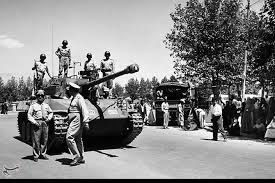
The Coup of August 16, 1953
On August 14, 1953, according to the CIA’s plan known as TP-Ajax to overthrow Mossadiq’s government, the Shah signed two decrees: one dismissing Mossadiq as Prime Minister and the other appointing General Zahedi in his place. Colonel Nassiri, head of the Shah’s Guard, was tasked with surrounding Mossadiq’s residence, delivering the decree to him, and arresting him. Forces from the Guard also detained several of Mossadiq’s ministers, including Fatemi, the Deputy Prime Minister and Foreign Minister; Haghnass, the Minister of Transportation; and Zirakzadeh, a parliamentary representative and one of the leaders of the Iran Party. Meanwhile, groups of military personnel occupied the central telephone office in the Bazaar, severing communications. Mossadiq became aware of the plot through his Tudeh Party officers network, which included Nour-Eddin Kianouri, a key Tudeh figure and Mossadiq’s relative by marriage.
The arrest team also targeted the Army Chief of Staff, breaking into General Riahi’s house, exchanging gunfire with guards, and succeeding in arresting Dr. Fatemi, Engineer Haghshenass, and Engineer Zirakzadeh. The Prime Minister was informed of the events by two women who observed Fatemi inside an army jeep under arrest. Due to General Riahi’s absence from the Joint Chiefs’ Headquarters, the team failed to detain him. Meanwhile, Colonel Kiani, General Riahi’s deputy, was apprehended by Guard officers at Bagh-i-Shah, where he had come to conduct an inspection. The detainees were taken to Saadabad Palace and imprisoned there. At midnight, Colonel Nassiri attempted to deliver the Shah’s order and arrest Mossadiq at his residence, but the Prime Minister’s security forces, led by Colonel Momtaz and Captain Fesharki, detained Nassiri and disarmed his forces.
The following day, Mossadiq issued a brief statement announcing the discovery and thwarting of a coup against his government but made no mention of the Shah’s decree/farman. Upon learning of the coup’s failure, the Shah fled from Ramsar to Baghdad. Following reports of the Shah’s departure from Iran and his arrival in Baghdad, Hussein Fatemi ordered Iranian embassies, including the one in Baghdad, to oppose the Shah. From this day onward, Tudeh Party forces began creating disturbances in Tehran.
On August 17, both major groups—the Tudeh Party and the National Front—held fervent anti-Shah rallies. At the National Front rally in Baharestan, Mossadiq’s allies, such as Fatemi and Allahyar Saleh, harshly criticized the Shah in an unprecedented manner despite Mossadiq’s absence. In the editorial of Bakhtar-i Emrouz, Fatemi accused the Shah of treason. That day, to prevent further disorder by Tudeh members, government agents, and National Front supporters, posing as protesters and vandals under Mossadiq’s instruction, removed the statues of the Shah and his father from city squares, as acknowledged by Mossadiq in military court. He asserted that this action was to prevent saboteurs from damaging the statues so that, upon the Shah’s return, they could be restored, indicating that the events of those four days had followed a pre-arranged scenario, with Mossadiq assured of the Shah’s return and the continuity of his monarchy.
Due to the escalating unrest on August 17 and 18, Mossadiq instructed General Modabber, head of the police, to suppress any anti-government or anti-Shah demonstrations. In light of the Shah’s absence, Mossadiq’s government considered establishing a Regency Council to manage the country’s affairs in Mohammad Reza Pahlavi’s absence, ensuring the monarchy continued as before.
On August 18, U.S. Ambassador Henderson returned to Tehran on a military plane[1] and delivered an ultimatum to Mossadiq, warning that if he allied with the Tudeh Party, the United States would no longer recognize his government; which meant that up to that day Mossadiq was regarded as prime minister and the Ambassador do not recognize the decrees of Shah for dismissing Mosadeq and installing Zaherdi as new prime minister. Mossadiq assured Henderson that he had control over the situation, which bears much reflection, and he would never allow the Tudeh Party to incite chaos. In response to the American ambassador’s inquiry about his stance on the Shah, Mossadiq stated, “Today, I have issued strict orders to prosecute anyone speaking of a republic, as we intend to request his imperial majesty, the Shah, to return to Iran as soon as possible, since regime change would not lead to the nation’s progress.”
The Coup of August 19, 1953
On August 19, 1953, another move against the government took place, which ultimately led to the overthrow of Mossadiq’s administration. According to CIA operative Kermit Roosevelt in his book Countercoup, he instigated the coup by bribing certain clerics and paying off soldiers, vagrants, and thugs to take to the streets. U.S. embassy vehicles in Tehran transported Royal Guard troops and soldiers to Mossadiq’s residence, distributing dollars to incentivize those involved in the coup, ensuring a success that had previously failed on August 16.
Around 8:00 a.m. on August 19, a crowd of approximately three thousand men armed with clubs gathered in the southern part of the city, protesting against Mossadiq and voicing support for the Shah. They chanted slogans like “Long live the Shah” and “Death to the traitor Mossadiq.” Today, it is widely known that many of these men were hired for this purpose; the crowd included many unemployed people and well-known thugs. The police chief, who had already been bribed, instructed his officers not to interfere with the demonstrations. Part of the crowd moved toward the Bazaar, threatening to loot shops, which immediately caused the merchants to close down. As time passed, the crowd grew, and some ordinary Tehranis, disillusioned with Mossadiq’s government, particularly its recent support for the Tudeh Party, joined the protests. Soon, trucks and buses that had been rented since early morning began transporting demonstrators across the city, where they would shout slogans, inciting public anger and rallying support for the Shah.
It quickly became evident that the police were supporting the protests and, in some cases, even directing the crowds. Mossadiq immediately dismissed the police chief and ordered his arrest. He also instructed the army to deploy tanks and armored vehicles to disperse the crowds. However, the orders were not obeyed immediately, and by the time they were executed hours later, the protesters had easily convinced the arriving soldiers to join them in support of the Shah. Between 9:00 a.m. and noon, the demonstrators attacked and burned down the headquarters of three pro-government political parties and the offices of six newspapers supporting Mossadiq. The crowd then turned to the Tudeh Party newspapers’ offices, which initially resisted but were soon overcome.
The demonstrators also assaulted the prison, where they freed Shaban Jafari (known as “Shaban the Brainless”), who had been imprisoned since March 9, 1953, for attempting to assassinate Mossadiq. The crowd occupied the radio station, and after several hours of unprecedented silence on Iranian radio, Mehdi Mirashrafi, a parliamentarian, and Mostafa Kashani, son of Aboulqasim Kashani, along with other anti-Mossadiq and pro-Shah parliamentarians, such as Ahmad Faramarzi, delivered speeches in support of Zahedi. Zahedi then read the decree appointing him as Prime Minister.
Next, the crowd moved toward Mossadiq’s house, which served as the Prime Minister’s residence. The initial attack by civilians was repelled by machine gun fire. A second attack, this time with the support of pro-Zahedi soldiers, was also unsuccessful. Heavy Sherman tanks eventually arrived, bombarding the house, and by around 6:00 p.m., the guards defending the Prime Minister’s residence were overpowered, and the house was destroyed. The assailants managed to enter and loot everything inside before setting the building on fire. The neighboring house, which belonged to Mossadiq’s son, suffered the same fate. By evening, the remaining prisoners detained during the August 16 coup attempt and those accused of plotting to assassinate Mossadiq on March 9 were freed, and General Zahedi took power.
According to Saeed Hekmat, head of the Forensic Medicine Department, the coup resulted in 41 deaths and 75 injuries. On this day, the Shah was in Rome, Italy. According to his wife, Soraya[2], he was considering purchasing a house there, assuming he might remain in exile. However, upon learning of Mossadiq’s fall, Zahedi’s assumption of power, and receiving telegrams of support from Abulqasim Kashani and Mohammad Behbahani, he was informed of the successful coup.
On August 20, Mossadiq and most of his allies surrendered to General Zahedi at the Officers’ Club, where Zahedi warmly and cordially welcomed him.
CIA’s Organization of the Coup
According to classified documents released by the Central Intelligence Agency (CIA) in August 2013, the agency admitted to playing a role in the August 19, 1953, coup against Mossadiq’s government. In the preface of one of these newly released documents, a 1954 report, the CIA states: “By late 1952, it was clear that the Mossadiq government would not reach an oil agreement with Western countries that had interests in Iran.” The document further states: “The goal of Operation Ajax was to overthrow Mohammad Mossadiq’s government, restore the Shah’s prestige and power, and replace Mossadiq’s administration with one that would govern Iran in a constructive manner.” The document also notes that the coup aimed to establish a government that Western powers could negotiate with regarding oil markets. In March 1953, the U.S. State Department asked the CIA to explore the feasibility of ousting Mossadiq’s government through covert operations. The CIA’s assessment concluded that such an operation was possible. Subsequently, it was decided that the CIA would collaborate with the British Secret Intelligence Service (SIS, known as MI6) to carry out the overthrow of Mossadiq. Kermit Roosevelt, head of the CIA’s Near East and Africa Division of the CIA, who had organized a coup against King Farouk in Egypt a year earlier, first met with Roger Goiran, head of the CIA station in Iran, along with two other intelligence officers in Beirut. Then, on June 14, 1953, Roosevelt presented the coup plan to the British Secret Intelligence Service.
[1] – مملکت آنقدر بی در و پیکر بوده که یک هواپیمای نظامی امریکایی می توانسته براحتی در فرودگاه تهران بزمین بنشیند؟ یا اینکه با اجازه مصدق این کار صورت گرفته بود؟
[2] – موضوع کودتا آنچنان محرمانه بوده است که ثریا اسفندیاری هم محرم راز نبوده است. زیرا عصر روزی که محمد رضا پهلوی و ثریا به روم وارد می شوند در هنگام صرف عصرانه یا شام در هتل آمباسادور روم، ثریا به او می گوید که من بخاطر این با تو ازدواج کردم که شاه بودی، حالا که دیگر شاه نیستی، پس بای بای!
 ADABSARA